Top 10 Mobile Device Management Solutions and Alternatives in 2026


See Venn first in Google Search
Add as a preferred source on Google
Mobile Device Management (MDM) solutions let IT teams enroll, secure, and monitor smartphones, tablets, and laptops from one console. Best for BYOD without device takeover: Venn. Best for Apple fleets: Jamf Pro. Best for Microsoft shops: Intune. Best for rugged and IoT: SOTI MobiControl.
What Are Mobile Device Management (MDM) Solutions?
Mobile Device Management (MDM) solutions are security software that allows IT and security teams to monitor, manage, and secure employee smartphones, tablets, and laptops. They are primarily used to enforce corporate policies, deploy apps, and protect sensitive company data on both corporate-owned and personal (BYOD) devices.
MDM solutions typically cover smartphones, tablets, and laptops across iOS, Android, and Windows platforms. They provide centralized dashboards for device tracking, software distribution, configuration updates, and real-time policy enforcement.
Common MDM features include:
- Remote device actions: Lock, wipe, or reset devices remotely.
- Policy enforcement: Push out mandatory security and usage policies across all managed devices.
- App management: Distribute, update, and manage internal and third-party applications.
- Asset management: Track device inventory and usage.
- Remote troubleshooting: Remotely diagnose and resolve device issues.
How MDM solutions work:
- Enrollment: The device is enrolled into the MDM system, either by the user installing a profile or through automated deployment programs.
- Configuration profile: A set of configuration profiles (rules and settings) is applied to the device to separate and protect work data from personal data.
- Continuous sync: The device continuously syncs with a central MDM server or console to maintain compliance and receive new commands from the IT team.
Mobile Device Management Solutions at a Glance
The table below summarizes the key differences between the solutions covered in this article. We explore each one in more detail in the sections that follow.
| Category | Solution | Best For | Key Strengths | Things to Consider |
|---|---|---|---|---|
| BYOD alternative | Venn’s Blue Border | Securing work on BYOD or unmanaged PCs and Macs | Local enclave, DLP, native app speed, full user privacy | Not a phone/tablet fleet MDM; some device slowness |
| BYOD alternative | Cisco Duo Premier | Identity-first access and VPN-less remote access | Phishing-resistant MFA, device trust, zero trust access | Access layer, not device management; higher-tier cost |
| BYOD alternative | Zscaler Multimode CASB | Governing data and access across SaaS and IaaS | Inline and API scanning, DLP, shadow IT discovery | Cloud proxy latency; advanced features cost extra |
| Traditional MDM | IBM MaaS360 | Multi-OS unified endpoint management | UEM, containerization, Watson AI analytics, patching | Dated interface; setup learning curve |
| Traditional MDM | Microsoft Intune | Microsoft-standardized organizations | Entra ID conditional access, cloud-native, Copilot | Steep learning curve; weaker non-Windows parity |
| Traditional MDM | ManageEngine Mobile Device Manager Plus | Mixed fleets, cloud or on-premises | Enrollment, kiosk mode, containerization, content mgmt | Limited Apple controls; cluttered interface |
| Traditional MDM | Jamf Pro | Apple devices at scale | Zero-touch deployment, day-one OS support, deep controls | Apple-only; scripting-heavy; premium pricing |
| Traditional MDM | LogMeIn Miradore | Small and mid-size cross-platform fleets | Simple setup, automation, security, multitenancy | Reporting and app deploy lag; fewer advanced features |
| Traditional MDM | Scalefusion | Broad multi-platform endpoint management | Kiosk mode, geofencing, remote control, conditional access | Learning curve; advanced settings less beginner-friendly |
| Traditional MDM | SOTI MobiControl | Rugged, IoT, and mixed field fleets | Lifecycle mgmt, IoT support, fast data delivery, geofencing | Limited iOS controls and reporting; support/pricing |
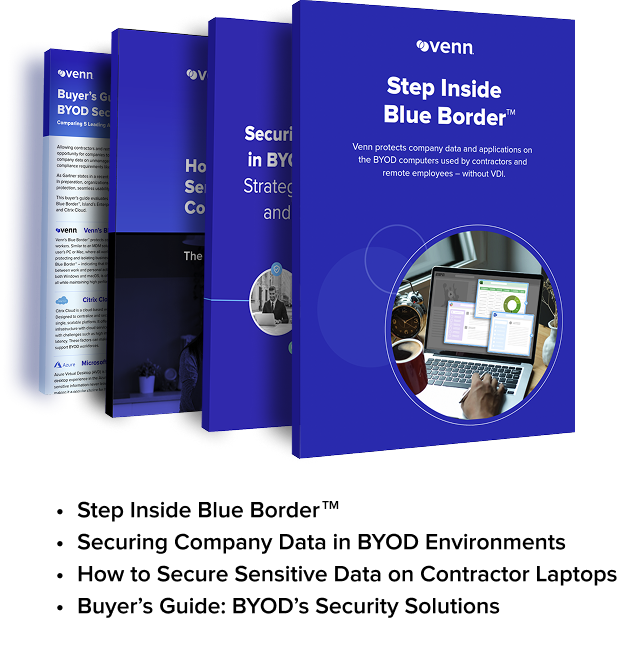
Get Your BYOD Security Toolkit
Unlock the 4 essential assets you need to secure company data on unmanaged laptops – without VDI
In this article:
- What Are Mobile Device Management (MDM) Solutions?
- Mobile Device Management Solutions at a Glance
- Core Capabilities of Mobile Device Management Solutions
- How Do MDM Solutions Work?
- Are MDM Solutions Suitable for a Modern BYOD Environment?
- Top 10 Mobile Device Management Solutions and Alternatives
- Considerations for Choosing Mobile Device Management Solutions
Core Capabilities of Mobile Device Management Solutions
1. Remote Device Actions
Remote device actions are a foundational capability of modern MDM platforms. These actions allow administrators to lock, wipe, or locate devices in the event of loss or theft, ensuring that sensitive information is protected from unauthorized access. For example, if a phone containing company data is lost, IT teams can remotely erase its content or disable it entirely to prevent data leaks.
Beyond security measures, remote actions facilitate device initialization and troubleshooting without requiring physical access to the hardware. Administrators can initiate device restarts, push configuration changes, or reset passwords remotely, reducing downtime and enhancing the organization’s ability to maintain a secure and consistent mobile environment.
2. Policy Enforcement
Policy enforcement is central to MDM solutions, enabling organizations to specify, deploy, and monitor compliance with device policies. Policies can dictate password requirements, data encryption, app installation restrictions, or network usage guidelines. MDM platforms ensure these rules are applied uniformly across all managed devices, reducing the likelihood of security gaps that could arise from inconsistent configurations or user behavior.
Continuous monitoring allows IT teams to detect and remediate policy violations in real time. Non-compliant devices can be quarantined, have restricted network access, or receive remediation prompts automatically. This proactive enforcement ensures that all devices maintain a prescribed security baseline, supporting regulatory compliance efforts and reinforcing the organization’s overall data protection posture.
Learn more in our detailed guide to BYOD policy
3. App Management
App management is another significant feature of MDM solutions, enabling administrators to control which applications can be installed, updated, or removed on managed devices. This includes distributing authorized business apps, blocking unapproved software, and patching vulnerabilities by ensuring apps are up to date. MDM solutions often include enterprise app stores, where users can find pre-approved applications tailored to their roles.
Effective app management reduces the threat surface by restricting the introduction of potentially harmful or unvetted software. It also streamlines the user experience by centrally distributing productivity tools and automating app updates. By managing the app lifecycle, organizations minimize security risks and help users remain productive without jeopardizing sensitive business information.
4. Asset Management
Asset management capabilities within MDM solutions give organizations visibility into their device fleet. Administrators can access detailed inventories, view device status, operating system versions, and installed applications. This data is crucial for planning upgrades, tracking hardware refresh cycles, and ensuring that unsupported or outdated devices are identified and either updated or retired as needed.
In addition to managing hardware and software inventories, asset management features can monitor device usage statistics and network activity. These insights help organizations optimize resource allocation, enforce cost controls, and align their technology investments with evolving business needs. Asset tracking also supports compliance audits and loss prevention initiatives by ensuring every device is accounted for throughout its lifecycle.
5. Remote Troubleshooting
Remote troubleshooting is a valuable MDM capability that allows IT teams to diagnose and resolve device issues without requiring in-person intervention. Through remote access tools, administrators can view device status, analyze logs, and initiate corrective actions such as rebooting or reconfiguring settings. These features are particularly useful in distributed organizations with a large number of remote or field employees.
Effective remote troubleshooting minimizes device downtime and user frustration, while also reducing support costs by minimizing the need for physical device handling or shipping. Quick problem resolution keeps employees productive and ensures critical devices remain operational.
How Do MDM Solutions Work?
Most MDM solutions follow a consistent workflow to bring devices under management and keep them compliant over time. Understanding this process helps clarify what IT teams take on when they deploy traditional MDM.
- Enrollment: The device is enrolled into the MDM system, either by the user installing a profile or through automated deployment programs such as Apple Business Manager, Android Zero-Touch Enrollment, or Windows Autopilot. Corporate-owned devices typically use automated enrollment, while BYOD devices often use invitation-based or self-enrollment so the organization controls only corporate data and apps.
- Configuration profile: Once enrolled, a set of configuration profiles (rules and settings) is pushed to the device over the air to configure Wi-Fi, VPN, security restrictions, and app installation rules, and to separate and protect work data from personal data.
- Continuous sync: The device continuously syncs, or checks in, with a central MDM server or console to maintain compliance and receive new commands from the IT team. If a device falls out of policy, the MDM can automatically restore the correct settings on the next sync.
Are MDM Solutions Suitable for a Modern BYOD Environment?
Traditional MDM solutions are often not well-suited to modern BYOD environments because they depend on full-device control, which conflicts with the personal nature of employee-owned devices. Enrolling a personal phone or laptop in an MDM program grants IT administrators broad access, potentially including visibility into installed apps, device configurations, and usage data. This raises privacy concerns and often leads to user resistance or noncompliance.
From a technical perspective, MDM platforms struggle to maintain consistent control across diverse devices and operating systems. Variations in hardware, OS versions, and manufacturer restrictions can limit enforcement of security policies like encryption, password complexity, or app blocking.
MDM also focuses on securing the device rather than the data or applications themselves. Once corporate data is accessible on a personal device, it becomes difficult to isolate and protect it without disrupting personal use. These limitations make MDM inefficient, intrusive, and unreliable for securing modern BYOD environments, which increasingly require app- and data-centric security approaches instead of device-level management.
Related content: Read our guide to BYOD security
Top 10 Mobile Device Management Solutions and Alternatives
How we selected these tools: We shortlisted mobile device management solutions and BYOD alternatives based on device enrollment and provisioning, policy enforcement, app and content management, security controls, remote troubleshooting, platform coverage, and how they handle unmanaged and personal devices.
MDM Alternatives for BYOD Environments
1. Venn’s Blue Border

Best for: Securing work on BYOD and unmanaged PCs and Macs without VDI
Strengths: Local secure enclave with DLP, no device takeover, full privacy
Things to consider: Focused on laptop/desktop work, not phone or tablet fleet MDM
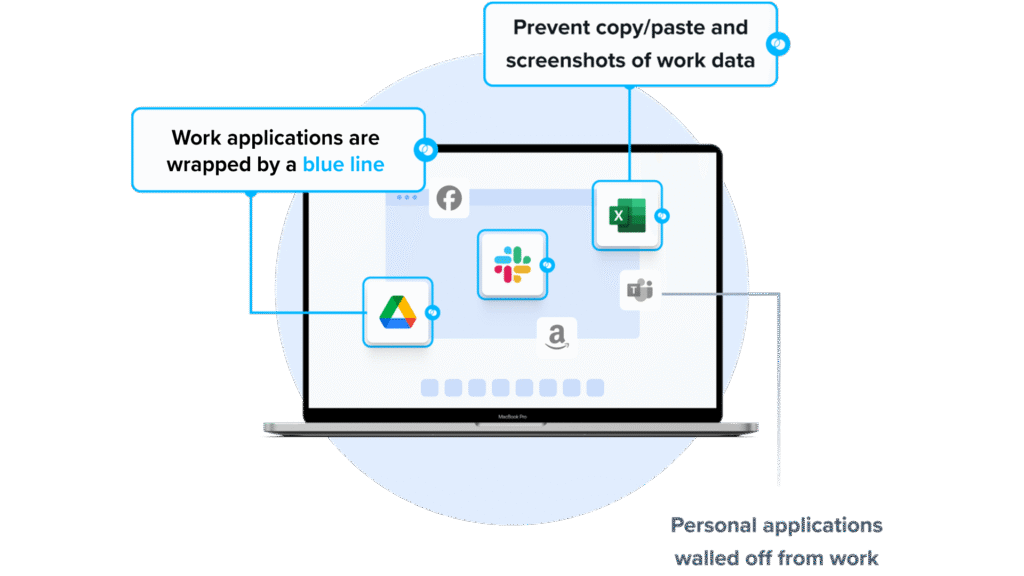
Venn’s Blue Border is software that isolates and protects company data and applications locally on any PC or Mac. Installing it creates a company-controlled secure enclave directly on the device. Work happens inside the enclave, where company data is encrypted, access is governed by IT, and activity is isolated from any other use on the same computer.
Work applications run inside the enclave, marked by a blue line around each application window. The enclave acts like a firewall around those apps, enforcing data loss prevention and controlling what data can move in and out. Anything outside Blue Border stays private and is not seen, tracked, or monitored by the company or Venn.
Key features include:
- Secure enclave on unmanaged devices: A local agent creates a company-controlled enclave on the user’s PC or Mac. Work applications run inside it while the rest of the device is untouched, so the company controls business activity without managing or hosting the whole device.
- Data isolation and DLP controls: The enclave governs what data can move in and out of work applications, with policies for copy, paste, printing, downloads, screen capture, and screen sharing. Company data inside the enclave is encrypted and separated from personal activity on the same machine.
- Local application performance: Work-sanctioned applications run natively on the endpoint rather than being streamed or virtualized. Blue Border protects installed apps including Chrome, Microsoft Office applications, Adobe, Slack, Zoom, Teams, VOIP tools, CAD and design tools, SAP, and custom business applications.
- Centralized administration without backend infrastructure: Because no backend infrastructure is required, IT teams can onboard and offboard remote employees and contractors in minutes. Centralized administration gives visibility into where, when, and from what device a user accessed an application or sensitive data.
- AI governance controls: IT can define which AI tools are authorized to interact with company applications and data inside the enclave. AI tools outside Blue Border are blocked from reaching protected information, even when they run locally on the same device.
- Compliance and user privacy: Venn is built to support regulatory standards including SOC 2 Type II, HIPAA, SEC, FINRA, NAIC, NYS DFS, Mass 201 CMR 17.00, CMMC, and PCI. Personal activity outside the enclave remains fully private, so users can use one computer for both work and personal tasks.
Limitations (as reported by users on G2):
- Performance on some devices: Some users report that the secure enclave can feel slow or that work applications run less smoothly on certain machines, including devices that meet the stated hardware requirements.
- Reporting depth: A few users would like more detailed reporting and broader visibility features than the platform currently offers.
- Customization scope: Some users note that customization options are somewhat limited, though they still find the platform effective for organizing and launching work applications.
2. Cisco Duo Premier
Best for: Identity-first access and VPN-less remote access to private apps
Strengths: Phishing-resistant MFA, device trust, and Duo Network Gateway
Things to consider: Access and identity layer, not a full device management console
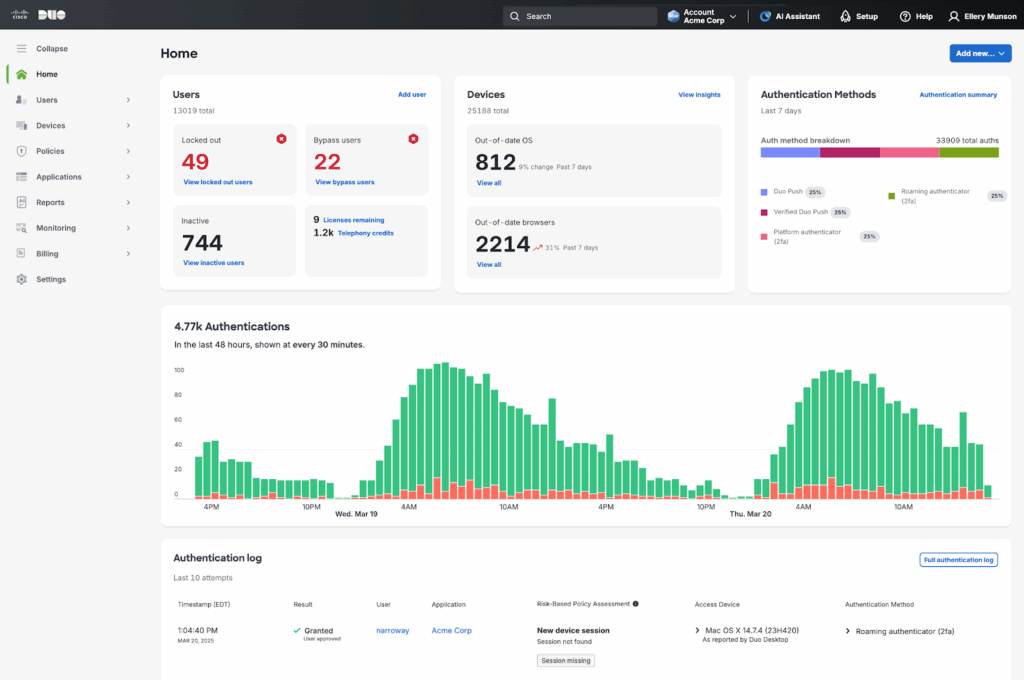
Cisco Duo Premier is the top edition of Cisco Duo’s identity and access security platform. It includes everything in Duo Essentials and Duo Advantage, plus VPN-less remote access through the Duo Network Gateway. It combines multi-factor authentication, adaptive access policies, and device checks to control who and what can reach applications.
Rather than managing the device itself, Duo verifies identity and device posture before granting access. Duo Network Gateway lets remote users reach specific private applications without exposing the network or the app to the public internet, applying zero trust policies so users reach only what they need.
Key features include:
- Phishing-resistant multi-factor authentication: Duo combines multiple authentication factors and supports FIDO2 authenticators and Verified Duo Push to resist phishing. Passwordless sign-in is available through Duo Mobile or FIDO2 authenticators, and Duo Passport removes repeated authentication prompts across devices.
- VPN-less remote access: Duo Network Gateway gives remote users access to private applications without a traditional VPN. Connections are brokered per application rather than to the whole network, and adaptive trust controls are applied to each connection.
- Device trust and health checks: Duo checks whether a device is registered or managed and verifies device health in real time before allowing access. Trusted endpoint policies can require that only known devices reach specific applications.
- Adaptive and risk-based access: Access requirements adjust based on role, device, and location, and can step up in real time in response to risk signals and device health. Policies are enforced consistently across cloud and on-premises applications.
- Single sign-on and directory: Duo provides single sign-on to federated cloud and on-premises applications, and Duo Directory acts as an identity store for users and non-human identities. Threat detection uses machine learning to flag ongoing attack attempts.
- Identity intelligence and agent controls: Cisco Identity Intelligence adds AI-assisted analysis across identity sources. Duo Agentic Identity, in early testing, extends visibility, governance, authentication, and authorization policies to non-human identities and AI agents.
Limitations (as reported by users on G2):
- Cost for smaller teams: Some users describe the platform as expensive compared with other MFA options, which can be a barrier for smaller organizations.
- Reporting depth on lower tiers: Some users note that reporting tools lack depth unless the organization is on a higher-priced edition.
- Internet dependency: Because Duo Push depends on a mobile device with internet access, some users find the reliance inconvenient, and offline access options are seen as limited.
- Push notification delays and fatigue: Some users report that push notifications can arrive late, especially on slow connections, and that frequent authentication prompts can become tiring over time.
- Policy configuration complexity: Setting up and tuning access policies can be involved, and some users find the configuration process complex.
Source: Duo
3. Zscaler Multimode CASB

Best for: Governing data and access across SaaS and IaaS from the cloud
Strengths: Inline and API scanning, DLP, shadow IT discovery, threat protection
Things to consider: Cloud proxy can add latency; part of a broader platform
Zscaler’s multimode Cloud Access Security Broker (CASB) governs how data and applications are used across SaaS apps and IaaS platforms such as Microsoft 365, Salesforce, and Amazon S3. It combines inline, real-time controls with out-of-band API scanning so admins can apply one set of policies across sanctioned and unsanctioned cloud services.
Inline security inspects data in motion through a proxy architecture with TLS/SSL inspection, while out-of-band security scans data at rest inside SaaS apps and cloud platforms through API integrations. The CASB is part of Zscaler’s security service edge (SSE) platform alongside secure web gateway, zero trust network access, and data loss prevention.
Key features include:
- Inline security for data in motion: A proxy architecture with TLS/SSL inspection applies real-time controls to cloud traffic. It can prevent uploads of sensitive data to sanctioned and unsanctioned apps with DLP and block known and unknown malware with threat protection.
- Out-of-band API security for data at rest: API integrations scan SaaS apps and public clouds such as AWS to identify sensitive data with DLP, crawl apps for risky file shares and revoke them by policy, and detect zero-day malware and ransomware in stored content.
- Shadow IT and app control: The CASB identifies unsanctioned apps used by employees and assigns a risk score. Access to specific apps, tenants, and app categories can be blocked, restricted, or set to read-only based on user group and device.
- Data loss prevention across cloud channels: Granular DLP policies apply across cloud apps to stop accidental or risky file shares and internal threats such as intellectual property theft, with consistent enforcement across SaaS and IaaS.
- Agentless BYOD security: Agentless cloud browser isolation secures BYOD and third-party devices that are not under IT management, allowing controlled access to cloud apps without installing software on the device.
- SaaS security posture and compliance: The platform surfaces and helps fix misconfigurations that put data at risk or jeopardize compliance, and consolidates visibility and reporting across SaaS apps and IaaS platforms in one console.
Limitations (as reported by users on G2):
- Performance and latency: Because traffic is routed through Zscaler’s cloud, some users report slower speeds and delays, particularly during peak hours or in certain regions.
- Initial setup and policy configuration: Some users find the platform complex to configure at first, especially around policy setup and management.
- Troubleshooting and log visibility: Determining why a specific site or application is blocked can be difficult, and some users would like deeper log visibility to build bypass or allowlist rules.
- Reporting customization: A few users report that the ability to customize reporting is limited, and occasional false positives require manual adjustments.
- Cost of advanced features: Pricing for more advanced capabilities may be a consideration for smaller organizations, and some advanced controls are add-ons.

Source: Zscaler
Traditional Mobile Device Management Solutions
4. IBM MaaS360
Best for: Multi-OS unified endpoint management with built-in threat defense
Strengths: UEM, containerization, Watson AI analytics, patch management
Things to consider: Interface feels dated; learning curve for new admins
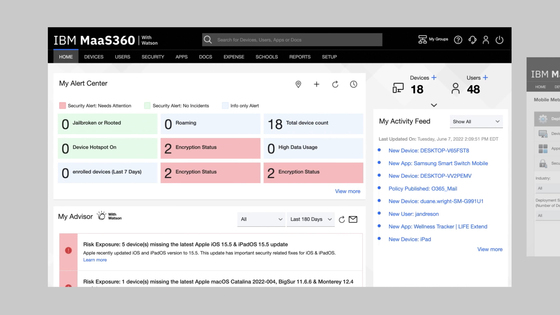
IBM MaaS360 is a cloud-based unified endpoint management (UEM) platform that manages and secures mobile devices, laptops, and other endpoints across multiple operating systems from a single console. It combines device management, application management, identity management, and threat protection, with analytics powered by Watson AI.
MaaS360 covers the full range from enrollment and policy enforcement to mobile threat defense and patching. A Fast Start option targets smaller businesses that need to onboard and secure phones and tablets quickly, while higher tiers add containerization, secure mail, content management, and an enterprise gateway.
Key features include:
- Unified endpoint management: MaaS360 manages smartphones, tablets, laptops, and desktops from one console, covering enrollment, configuration, and policy enforcement across operating systems for hybrid and frontline workforces.
- Mobile threat defense: Built-in threat detection protects users, devices, apps, and data from malware, man-in-the-middle attacks, and phishing, with on-device protection and automated responses to reduce exposure to zero-day threats.
- Containerization and data separation: An enterprise container separates corporate and personal data on a device, with secure mail, enterprise browser, and controls that keep business content within trusted apps and block third-party backup of distributed data.
- Watson AI analytics: Built-in Watson AI helps identify mobile threats and surfaces insights to guide endpoint security and management decisions, with policy recommendation and user risk management in higher tiers.
- Patch and app management: Granular patch management and application patching keep devices current, and app management lets IT distribute, configure, and control business applications across managed endpoints.
- Identity and access controls: Identity management, mobile expense management, and OS-level VPN and enterprise browser options extend control over how users reach corporate resources across the device fleet.
Limitations (as reported by users on G2):
- Dated interface: Several users describe the interface as feeling outdated or clunky in places, with some settings buried and requiring extra navigation.
- Setup and learning curve: New administrators can find the initial setup complex, and the breadth of settings and options can feel overwhelming at first.
- Reporting and customization: Some users note that reporting tools could be more flexible and that customization options are limited compared with other platforms.
- App deployment reliability: A few users report occasional glitches when packaging and deploying applications, with installs not always completing consistently.
- Support and battery use: Some users report occasional delays in support responses, and a few note higher battery consumption on smartphones running the agent.
Source: IBM
5. Microsoft Intune

Best for: Endpoint management for organizations standardized on Microsoft
Strengths: Entra ID conditional access, cloud-native, Copilot guidance
Things to consider: Steep learning curve; weaker parity on non-Windows platforms
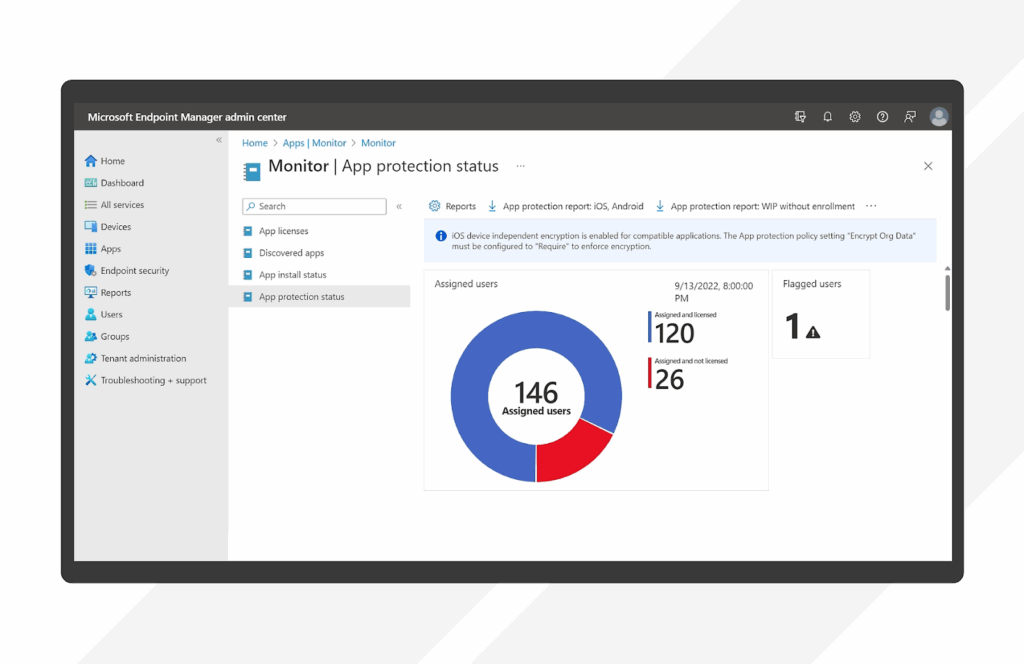
Microsoft Intune is a cloud-based endpoint management solution that manages and secures smartphones, tablets, laptops, and desktops across Windows, Android, macOS, iOS, and Linux. It applies a zero trust approach, continuously verifying device compliance and controlling access to corporate resources through Microsoft Entra ID.
Intune unifies device and application management in one console and integrates closely with Microsoft 365. Advanced capabilities such as Endpoint Privilege Management, Remote Help, Advanced Analytics, and Enterprise Application Management are available through the Intune Suite, and Security Copilot adds AI-assisted guidance.
Key features include:
- Cross-platform endpoint management: Intune manages and protects cloud-connected endpoints across Windows, Android, macOS, iOS, and Linux from one console, and Configuration Manager handles on-premises Windows PCs and servers.
- Conditional access with Entra ID: Integration with Microsoft Entra ID enforces conditional access so only compliant, secure devices reach corporate applications and data, with app protection policies that can require MFA and encryption on personal devices.
- Application and update management: Enterprise Application Management deploys and updates apps across platforms, and Intune patches vulnerabilities and keeps apps current, with app-based VPN access controls and firmware over-the-air updates in advanced mobility management.
- Security Copilot and automation: Security Copilot in Intune provides actionable recommendations and AI-powered guidance to speed up management decisions and issue resolution, while automation handles routine tasks.
- Advanced analytics and remote help: Advanced Analytics gives endpoint health visibility across the fleet with device query capabilities, and Remote Help enables secure, cloud-based helpdesk-to-user connections.
- Endpoint privilege and certificate management: Endpoint Privilege Management lets standard users perform only IT-approved elevated tasks, and Microsoft Cloud PKI automates cloud certificate management across managed devices.
Limitations (as reported by users on G2):
- Learning curve: Many users describe a steep learning curve, noting that it takes time and expertise to become comfortable with the platform and that setup can be daunting.
- Cross-platform parity: Some users feel support for Apple, Linux, and some Android controls is not as complete as for Windows, and that certain capabilities work best with Microsoft apps.
- Licensing and cost complexity: Some users find the differences between licensing tiers confusing and note that add-on costs for capabilities such as patch management can add up.
- Interface and deployment delays: A few users report that the web interface can feel slow or that settings move around, and that some app or policy deployments are slow to reflect accurate status.
- Reporting and multi-portal troubleshooting: Some users note that reporting could be more customizable and that resolving issues can require navigating across several administrative portals with vague error messages.
Source: Microsoft
6. ManageEngine Mobile Device Manager Plus

Best for: Managing mixed fleets with cloud or on-premises deployment
Strengths: Enrollment, kiosk mode, containerization, geofencing, content mgmt
Things to consider: Limited Apple controls; interface can feel cluttered at first
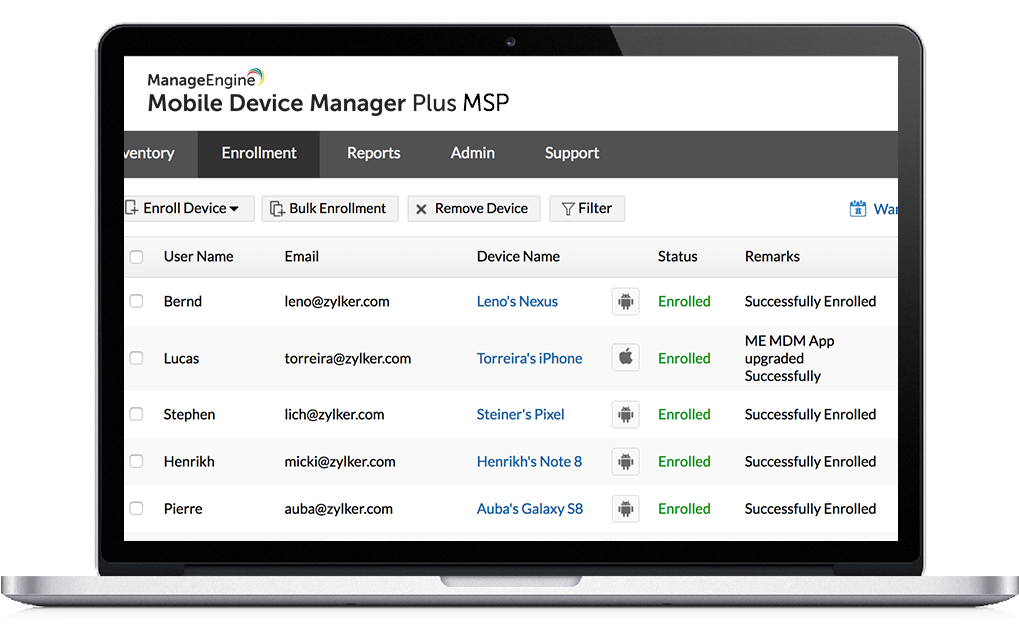
ManageEngine Mobile Device Manager Plus is a device management solution that lets IT teams manage and secure smartphones, tablets, laptops, and desktops across Apple, Android, Windows, and Chrome OS from one interface. It is part of ManageEngine, the enterprise IT management division of Zoho Corporation, and supports both cloud and on-premises deployment.
The product covers the full mobile lifecycle from onboarding to retirement, including enrollment, configuration profiles, app distribution, security policy enforcement, and containerization that separates corporate and personal data. It also provides email management, content management, and remote troubleshooting.
Key features include:
- Enrollment and configuration: Devices are brought under management through enrollment and authentication for BYOD and corporate devices, and configuration profiles enforce policies for Wi-Fi, VPN, and other parameters across the fleet from a single dashboard.
- Application management and kiosk mode: IT can distribute and manage in-house and store apps for iOS, Android, macOS, Chrome OS, and Windows, fetch granular app details, manage licenses, and lock devices to a single app or a set of apps with Kiosk Mode.
- Security management: Administrators can monitor devices and issue remote lock and wipe commands on lost devices, detect jailbroken and rooted devices, and apply role-based device usage permissions and customizable access to corporate accounts.
- Containerization and email control: Corporate and personal data are separated on each device, with enterprise data stored in an encrypted container. Email access follows Conditional Exchange Access, and attachments open only through managed apps, with support for Office 365 and Microsoft Entra ID.
- Content management: Documents are distributed and managed on devices, viewed and saved only through trusted apps, updated automatically when newer versions are available, and protected from third-party cloud backup, with support for more than ten document formats.
- Remote troubleshooting and tracking: IT can remotely control and view devices to troubleshoot issues in real time, and higher tiers add geotracking, geofencing, remote control, and conditional access policies for the managed fleet.
Limitations (as reported by users on G2):
- Apple ecosystem controls: Some users report that functionality for macOS and iOS is limited, and that enrollment for Apple devices can be more cumbersome and occasionally fails.
- Interface organization: Some users find that the same task can be performed in multiple places, which can be confusing, and that parts of the interface feel cluttered.
- Initial setup complexity: New administrators can find the initial setup and configuration complex, with some important settings difficult to locate at first.
- Feature gaps: A few users note that capabilities such as nested group and sub-group structures are missing compared with some other MDM products.
- Remote support constraints: Some users mention limitations such as the inability to remotely operate devices without user consent, and occasional buggy behavior when the client pushes policies over managed Wi-Fi or LAN.
Source: ManageEngine
Get Your BYOD Security Toolkit
Unlock the 4 essential assets you need to secure company data on unmanaged laptops – without VDI
7. Jamf Pro

Best for: Managing and securing Apple devices at scale
Strengths: Zero-touch deployment, day-one OS support, deep Apple controls
Things to consider: Apple-only; scripting-heavy and priced at a premium
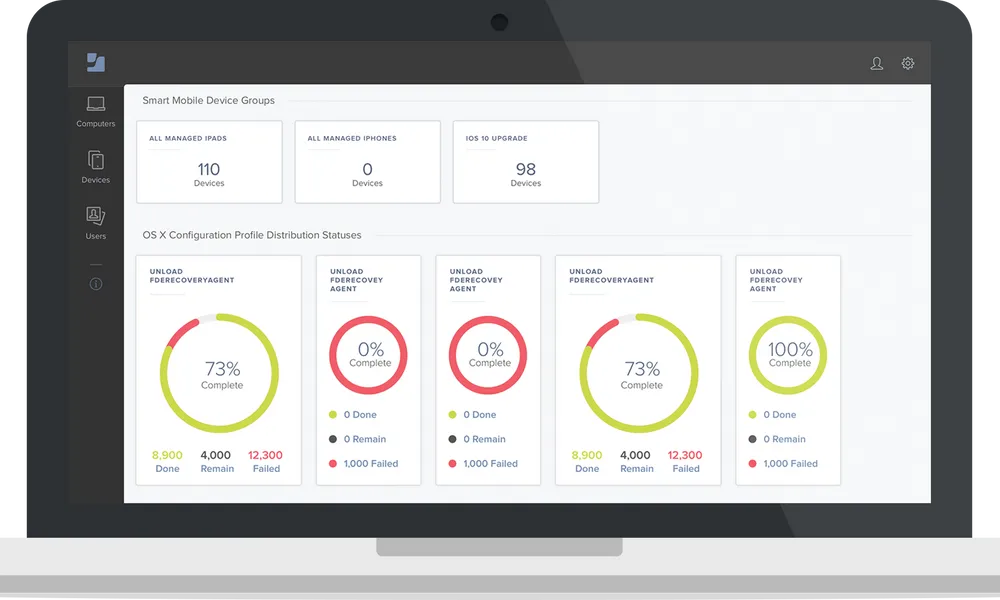
Jamf Pro is a device management solution focused on the Apple ecosystem, covering macOS, iOS, iPadOS, Apple TV, and Apple Watch. It provides configuration, security, and deployment using native Apple features, and it fits into Windows-centric environments while also supporting Android for mixed-fleet mobility.
Jamf Pro goes beyond configuration profiles with policies and scripts, and its management and security features work without user interaction. IT teams get automation, Apple endpoint telemetry, and continuous compliance monitoring, and support for new Apple features is typically available as Apple releases them.
Key features include:
- Zero-touch deployment: Mac, iPhone, iPad, and Apple TV can be provisioned hands-free through Automated Device Enrollment, including BYOD, so devices are configured and ready for users out of the box.
- Declarative device management: Device settings, commands, app installations, and restrictions are managed across Apple devices with Declarative Device Management, standardizing configuration at scale.
- Inventory management: Jamf Pro automatically collects hardware, software, and security configuration details from Apple devices, giving IT a detailed inventory and the ability to scope actions to specific groups.
- App lifecycle management and Self Service: Automated, secure app management delivers apps to users, and Self Service+ lets users install apps, update software, and maintain their own devices without direct IT involvement.
- Compliance benchmarks: Automated configurations apply device security baselines based on industry benchmarks, so IT can harden devices and enforce consistent compliance across the Apple fleet.
- Patching and integrations: Jamf Pro patches Apple devices and restricts malicious software without user interaction, and it integrates with existing identity and security tools to fit an organization’s technology stack.
Limitations (as reported by users on G2):
- Learning curve: Several users describe a steep learning curve and note that effective use often depends on training or a scripting background.
- Reliance on scripting: Some users find that standard tasks such as app auto-updates, self-service, and dock configuration can require scripts and workarounds.
- Pricing: Pricing is a frequently cited drawback, particularly for smaller organizations, and some point to add-on costs for related modules.
- Interface navigation: Some users report friction navigating the interface and difficulty locating settings without prior experience.
- Apple-only scope: Because Jamf Pro centers on Apple devices, organizations with mixed fleets need a separate solution for Windows and other non-Apple platforms.
Source: Jamf
8. LogMeIn Miradore

Best for: Straightforward cross-platform MDM for small and mid-size teams
Strengths: Simple setup, automation, security, and multitenancy
Things to consider: Reporting and app deployment can lag; fewer advanced features
LogMeIn Miradore, offered by GoTo, is a cloud-based MDM solution that manages Android, Apple, and Windows devices from a single platform. It is aimed at IT admins and managed service providers who need to secure and control company-owned and personal devices, with a free tier and paid plans that unlock additional features.
Miradore covers security, device control, and automation. IT can encrypt confidential data, separate business and personal use, enforce passcodes and screen locks, and prevent unwanted applications, while automation features such as Business Policies speed up enrollment and configuration and reduce manual work.
Key features include:
- Security and compliance: Miradore encrypts confidential data, separates business and personal use, enforces passcodes and screen locks, and prevents the use of unwanted applications to help maintain device and data compliance across the organization.
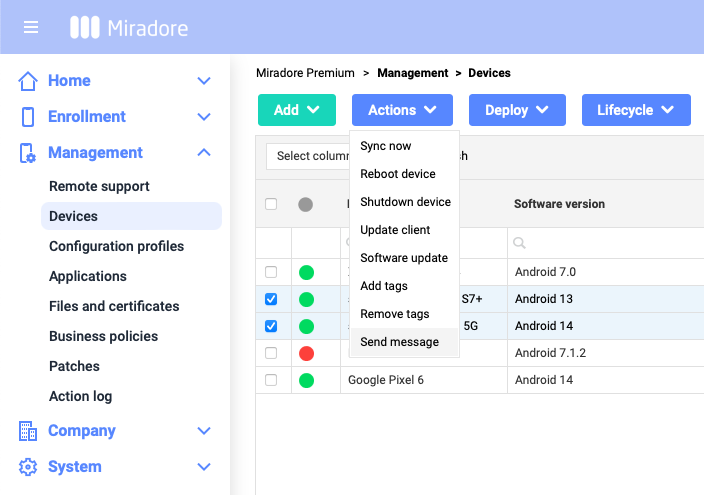
- Device control and configuration: IT can install configuration profiles remotely, manage which applications are used, and enforce restrictions and kiosk mode across Android, iOS, macOS, and Windows devices from one console.
- Automation with Business Policies: Business Policies automatically apply settings, applications, and files to devices that meet predefined conditions, so enrollment and configuration happen faster and with fewer manual steps and errors.
- Application and patch management: The platform deploys, removes, and controls applications, manages software licenses, and includes patch management to keep devices current.
- Inventory, reporting, and dashboards: Customizable dashboards and reporting tools give visibility into the device fleet, with inventory information and the latest status of application and configuration deployments per device.
- Multitenancy and remote support: Multitenancy supports managed service providers overseeing multiple customer environments, and remote support is available through integration with GoTo Resolve or TeamViewer.
Limitations (as reported by users on G2):
- Reporting and analytics: Some users feel the reporting and analytics could be improved, citing room for better clarity and customization.
- Application deployment: A few users describe application deployment as laggy, with uncertainty about when a process has fully completed.
- Update and sync timing: Some users report that pushing software updates or syncing a device manually can take a long time, with limited visibility into progress.
- Advanced feature gaps: A few users note that some advanced options are missing compared with pricier competitors, and that Linux support is not available.
- Support hours: Some users report challenges reaching live support due to limited hours and time-zone differences.
Source: Miradore
9. Scalefusion

Best for: Unified endpoint management across a broad range of platforms
Strengths: Kiosk mode, geofencing, remote control, conditional access
Things to consider: Learning curve; some advanced settings less beginner-friendly
Scalefusion is a device management solution that provides unified endpoint management across Android, iOS, iPadOS, macOS, Windows, Linux, and ChromeOS from a single console. IT teams can set policies, deploy apps, manage OS updates, and secure endpoints, including rugged devices and shared devices.
The platform combines device management with identity and access through Scalefusion OneIdP and endpoint security and compliance through Veltar. Policies defined once sync automatically to enrolled devices, and conditional access ties app and email access to real-time device compliance.
Key features include:
- Device enrollment and policy enforcement: Devices are enrolled with low or no end-user intervention across out-of-box protocols, and profiles enforce passcodes, app settings, and restrictions on BYOD or corporate-owned devices, including dynamic policies that change by time of day.
- Kiosk mode: Single-app and multi-app kiosk modes lock devices to approved apps, with a kiosk browser, website allow and block lists, role-based access, and the ability to disable hardware buttons for purpose-built devices.
- Location tracking and geofencing: Live location tracking with configurable frequency, circular and polygonal geofences, and route mapping let IT monitor mobile assets and switch policies based on whether a device is inside or outside a geofence.
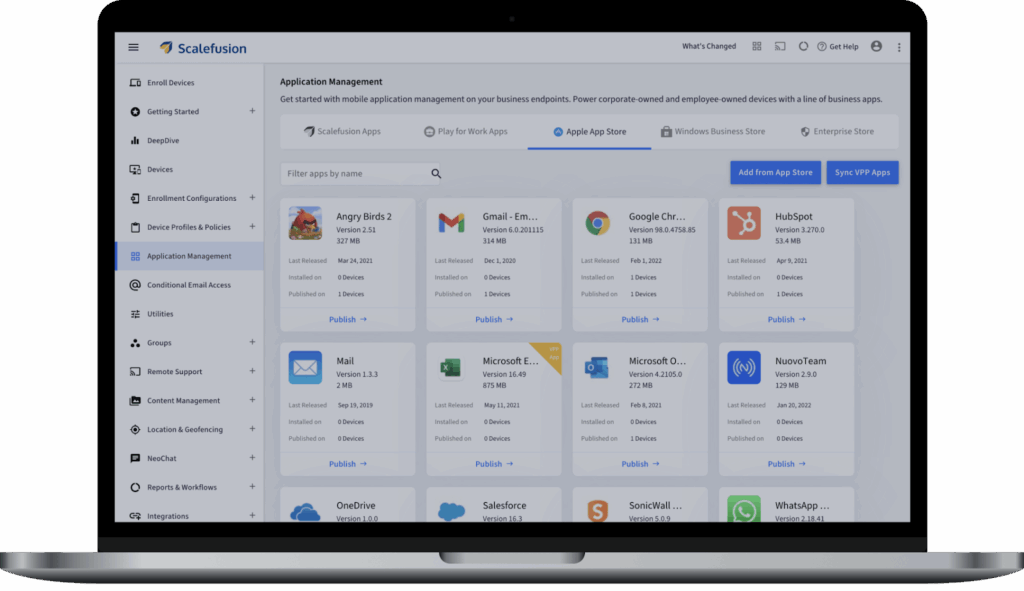
- Application and content management: IT distributes, configures, installs, and updates apps for iOS, Android, macOS, Chrome OS, and Windows without end-user intervention, manages app licenses and inventory, and pushes content and media to endpoints.
- Remote control and shared devices: Screen mirroring and screen control allow remote troubleshooting and file transfer, support tickets can carry screenshots and recordings to ITSM platforms, and shared device mode gives each user their own policies on a common device.
- Conditional access and compliance: OneIdP adds a zero trust access layer with SSO, endpoint authentication, and conditional access based on device compliance, and automated compliance monitoring with remediation keeps devices aligned to policy.
Limitations (as reported by users on G2):
- Learning curve: Some users report a learning curve, noting that certain configurations are not straightforward at first and can extend the onboarding process.
- Finding settings: A few users find that locating a specific option or setting can be time-consuming and would like better search or indexing within the console.
- Advanced configuration: Some users note that advanced settings such as certificate deployment and VPN configuration could be more user-friendly for less technical administrators.
- Automation and customization limits: A few users feel that some advanced automation and customization options are restricted, which can slow certain operations.
- Blocklisting workflow: Some users find blocking a device cumbersome, since it can require moving the device between groups or profiles rather than a single action.
Source: Scalefusion
10. SOTI MobiControl

Best for: Rugged, IoT, and mixed fleets in field-heavy industries
Strengths: Lifecycle management, IoT support, fast data delivery, geofencing
Things to consider: iOS controls and reporting limited; support and pricing concerns
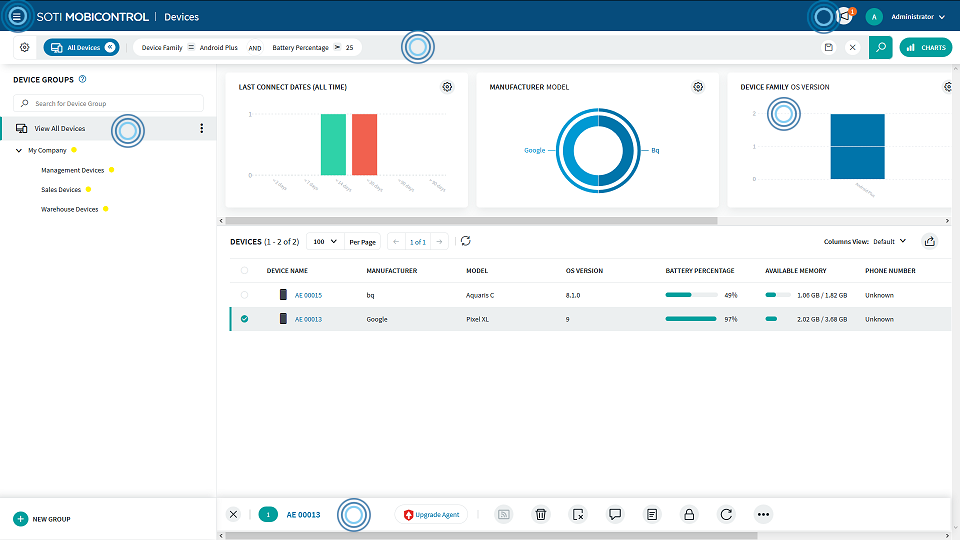
SOTI MobiControl is an enterprise mobility management (EMM) solution that provides visibility and control over where business-critical mobile devices are, what they are doing, how they are performing, and what security or compliance risks they face. It manages multi-vendor, multi-form-factor, and multi-OS devices, including rugged and IoT endpoints.
MobiControl covers the full device lifecycle across Android, Apple, Windows, and Linux, with rapid enrollment methods, geofencing, shared-device options, and secure content and application management. SOTI XTreme Technology optimizes data delivery to remote sites with limited bandwidth.
Key features include:
- Full lifecycle device management: MobiControl secures and manages devices and endpoints through their entire lifecycle, from enrollment and provisioning to ongoing configuration and eventual retirement, across a wide range of hardware.
- Express enrollment and provisioning: Multiple enrollment methods bring devices online quickly, including SOTI Stage, Apple DEP, Android Zero-Touch Enrollment, Samsung KME, Windows Autopilot, and Zebra StageNow.
- Geofencing and shared devices: IT can create geofences of any shape to track device location and deploy policies, apps, and content based on whether a device is inside or outside a fence, and shared-device configurations give each user a personalized experience on common hardware.
- IoT and OS management: MobiControl manages Linux-based mobile devices and IoT endpoints alongside phones and tablets, and handles OS and firmware management across Android, Apple, Windows, and Linux from one console.
- Content and application management: SOTI Hub and SOTI Surf provide secure content management and browsing, while flexible application management deploys and updates line-of-business apps across the multi-OS environment with the right versions for the right workers.
- Optimized data delivery: SOTI XTreme Technology and SOTI XTreme Hub optimize data communication for sites with limited bandwidth, reducing the time to distribute apps and data to large numbers of remote devices.
Limitations (as reported by users on G2):
- Performance at scale: Some users report that performance can lag in large environments, particularly when managing updates or pushing configurations across thousands of devices.
- iOS and macOS capabilities: A few users note that control and features for iOS and macOS are more limited compared with Android and Windows.
- Reporting flexibility: Some users find that reporting lacks adequate filtering or customization options.
- Application upgrades: A few users describe app upgrade workflows as cumbersome, and navigating deeper settings can be challenging.
- Pricing and support: Some users point to the pricing model and onboarding as limiting factors, including annual price increases, and a few report inconsistent support experiences.
Source: SOTI
Considerations for Choosing Mobile Device Management Solutions
While MDM platforms are widely used, many of their foundational assumptions do not align with the needs of modern organizations, especially those embracing BYOD, hybrid work, and decentralized IT. Choosing an MDM solution often means accepting significant trade-offs in cost, complexity, privacy, and user experience:
Challenges in BYOD environments: MDM platforms rely on full-device control, which is intrusive for employees using personal devices. This model creates friction and privacy concerns, leading to low adoption and enforcement challenges. Attempting to manage both personal and corporate data on the same device introduces legal, technical, and ethical complications.
Operational overhead: Effective MDM requires continuous configuration, policy tuning, and maintenance of enrollment workflows, compliance settings, and device groups. IT teams must also deal with platform fragmentation—supporting varied operating systems, hardware types, and use cases—all while responding to updates from mobile OS vendors. This adds ongoing complexity and consumes valuable IT resources.
Inconsistent user experience: MDM policies can interfere with native device features, leading to degraded performance, blocked apps, or restrictions that frustrate users. Remote troubleshooting, while useful, often falls short in real-world scenarios due to limited diagnostic data or inconsistent support across device types and OS versions.
Scalability issues: As organizations scale, managing large fleets of devices through MDM becomes increasingly difficult. Enrollment processes break down, compliance gaps widen, and policy updates take longer to propagate across distributed teams. Even cloud-based MDM platforms require careful planning and monitoring to avoid bottlenecks and misconfigurations.
Poor fit for application-centric models: MDM tools are designed around securing devices—not applications or data directly. In environments where the focus is on secure access to business applications and services rather than managing the device itself, MDM adds unnecessary overhead. It does little to protect data movement across unmanaged applications or user actions outside corporate control.
Modern security models, such as workspace isolation, app-level controls, and zero trust access, offer more practical, scalable solutions for today’s workforce. Tools like Venn shift control away from the device and toward the data and applications, reducing administrative overhead while respecting user privacy and maintaining strong security controls. These alternatives better align with hybrid work, contractor access, and BYOD needs without the heavy footprint of traditional MDM platforms.